

 EN
EN
How Brush Design Impacts Road Sweeper Efficiency
Bristle Geometry and Debris Handling: Lift, Containment, and Dust Suppression
Bristle geometry directly governs how a road sweeper lifts debris, contains it within the sweeping path, and suppresses dust. Straight-profile bristles generate strong mechanical lift—ideal for heavy, coarse material like gravel—while curled or crimped fibers increase surface contact points, enhancing capture of fine dust and silt. Containment relies on a continuous sweeping “curtain”; staggered or overlapping bristle patterns minimize gaps that allow particles to escape laterally. Effective dust suppression requires sufficient bristle density to trap airborne fines—often supported by integrated water spray systems. Optimizing these three interdependent functions—lift, containment, and suppression—is foundational to brush performance. Field data from the U.S. Department of Transportation’s Federal Highway Administration confirms that application-specific brush designs can improve overall sweeping efficiency by up to 30% compared to generic configurations.
Physics of Contact: Bristle Deflection, Pressure Distribution, and Energy Transfer in Road Sweeper Brushes
Each bristle’s interaction with the pavement follows predictable mechanical principles. As the brush rotates, individual bristles deflect elastically upon impact, storing then releasing kinetic energy to flick debris toward the hopper. Exceeding the elastic limit causes permanent set—a key wear mechanism that reduces cleaning consistency and increases maintenance frequency. Uniform pressure distribution across the brush face ensures even contact, preventing streaking and missed zones. Energy transfer depends critically on bristle stiffness, rotational speed, and the coefficient of friction between bristle tip and surface: stiffer bristles deliver more force to large objects but may glide over fine particulates without dislodging them. To address mixed-debris environments, leading manufacturers—including Elgin Sweeper and Bucher Municipal—now deploy variable-stiffness bristles or segmented brush sections calibrated via real-time load sensing. This physics-informed design improves cleaning efficacy while reducing motor strain and fuel use.
Side Brushes vs. Central Cylindrical Brushes in Road Sweeper Systems
Functional Roles: Gutter Clearance with Side Brushes vs. Mid-Lane Aggregation with Central Rollers
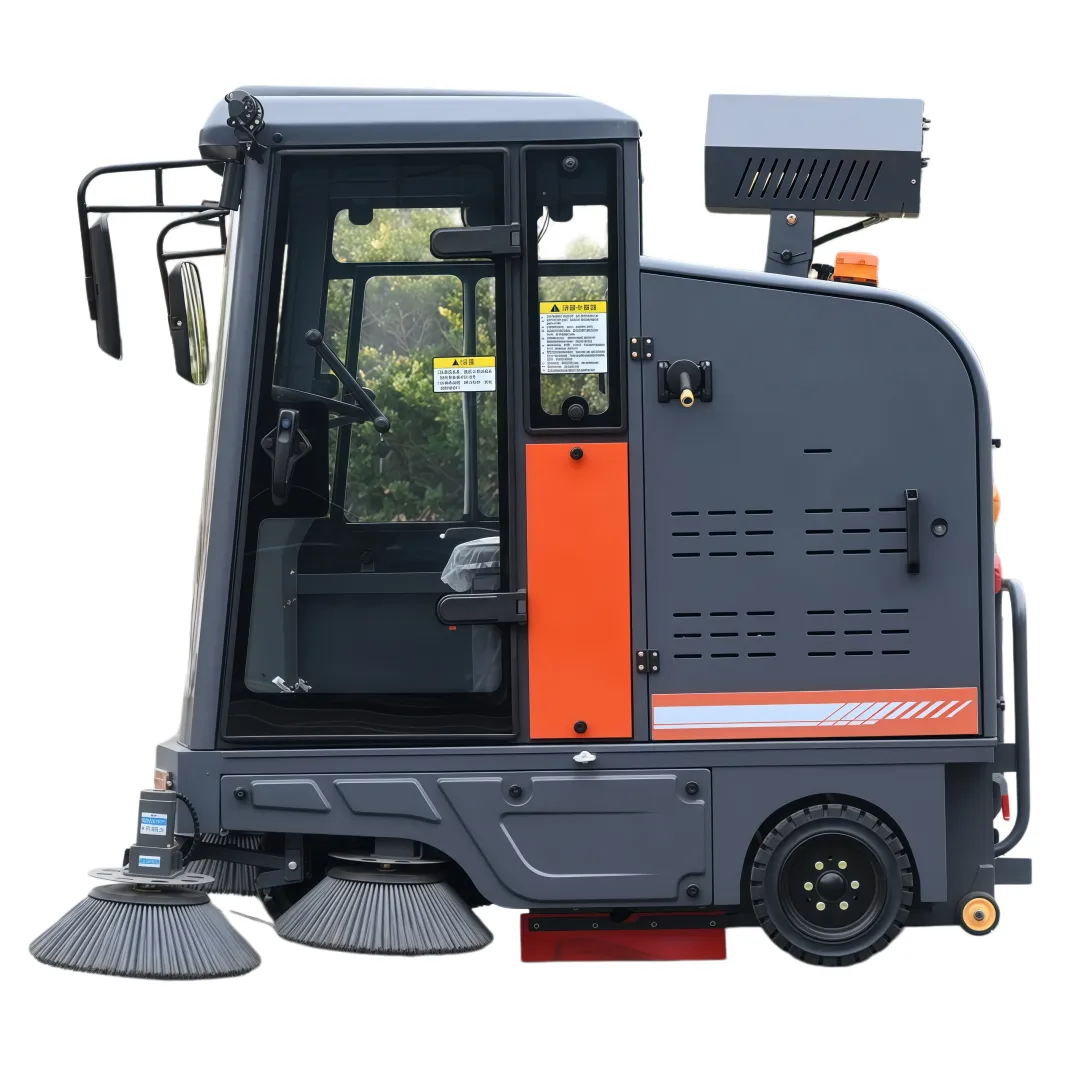
Side brushes are engineered for precision perimeter cleaning: their angled mounting and inward rotational direction actively sweep curb lines, gutters, and sidewalk edges into the central collection path. Central cylindrical brushes—typically mounted beneath the chassis—focus on mid-lane aggregation. Their counter-rotating, cylindrical configuration generates upward lift, channeling debris into the hopper with minimal scatter. This functional specialization enables full-width coverage without redundancy: side brushes manage accumulated edge debris, while central rollers handle the high-traffic travel lane. The result is coordinated, gap-free cleaning validated in AASHTO-standardized sweep tests across urban and arterial roadways.
Performance Drivers: Angular Velocity, Torque Allocation, and Synchronization in Modern Road Sweeper Configurations
Optimal brush performance rests on tightly controlled mechanical parameters. Angular velocity determines debris trajectory—higher RPM increases throw distance but risks aerosolizing fine particles; lower speeds improve control but reduce throughput. Torque allocation ensures balanced power delivery across brush systems, preventing motor overload during sudden encounters with dense debris piles. Modern sweepers integrate CAN bus–based control architectures that synchronize brush operation using input from debris sensors, GPS mapping, and surface condition algorithms. For example, advanced controllers—such as those deployed in the Bosch Intelligent Sweeping System—automatically reduce central brush RPM when side brushes detect curb-side accumulation, preserving containment integrity while maintaining system-wide fuel efficiency. This adaptive coordination reflects industry-wide progress toward intelligent, condition-responsive sweeping.
Brush Performance Across Debris Sizes: From Fine Dust to Coarse Gravel
Capture Thresholds: Why Sub-60-Micron Particles Challenge Conventional Road Sweeper Brushes
Conventional road sweeper brushes consistently underperform on particles smaller than 60 micrometers—the size range dominating urban PM10 emissions. These ultrafine particles embed deeply into pavement micro-texture, where stiff polypropylene or steel bristles cannot effectively penetrate or dislodge them. Surface adhesion forces (van der Waals and electrostatic) exceed the mechanical energy delivered by standard brush contact, resulting in redistribution—not removal. Visible dust plumes trailing behind sweepers are not just an aesthetic concern: they indicate non-compliance with EPA National Ambient Air Quality Standards (NAAQS) and contribute to respiratory health risks. Without targeted design interventions, municipalities face escalating cleaning cycles and higher lifecycle costs—without commensurate air quality improvement.
Innovations for Compliance: Hybrid Wafer-Strip Brushes and Low-Emission Zone Requirements
To meet tightening low-emission zone (LEZ) mandates—including those enforced in London, Paris, and California’s South Coast Air Quality Management District—manufacturers now integrate wafer and strip elements into single-brush cassettes. These hybrid designs combine rigid, segmented wafers for coarse debris lifting with flexible, high-surface-area strips that conform to pavement texture and retain fine particulates. When paired with low-pressure water misting or electrostatic assist, hybrid brushes achieve >85% capture of sub-60-micron particles, per independent testing by TÜV SÜD. Real-world deployments in LEZ-compliant fleets show a 40% average reduction in fugitive dust emissions versus conventional brushes. Because retrofitting only requires swapping brush cassettes—not replacing entire brush drives or hydraulics—the upgrade delivers rapid regulatory compliance at minimal capital cost.
Selecting Optimal Road Sweeper Brushes by Application and Regulation
Choosing the right brush requires aligning geometry, material, and system integration with site-specific conditions and regulatory obligations. In construction zones or industrial corridors dominated by gravel, slag, or bulky litter, stiff, abrasion-resistant bristles—such as crimped stainless steel or reinforced polypropylene—are essential for durability and mechanical lift. Urban arterials and residential streets, where fine dust, pollen, and organic debris prevail, benefit from softer, conforming materials like nylon wafer strips that maintain pavement seal and minimize scatter. Regulatory drivers—including EPA MS4 stormwater permits and LEZ air quality requirements—increasingly mandate ≥85% particulate capture efficiency. That demand has accelerated adoption of hybrid wafer-strip brushes, which balance coarse-lifting capability with fine-particle retention. By matching brush design to both operational context and compliance benchmarks, agencies maximize cleaning performance, extend brush service life, and ensure alignment with federal, state, and municipal environmental standards.
FAQ
How does bristle geometry affect road sweeper performance?
Bristle geometry impacts debris lift, containment, and suppression. Straight-profile bristles are ideal for lifting heavy materials, while curled or crimped fibers enhance fine dust capture and containment by minimizing gaps.
What are side brushes and central cylindrical brushes used for?
Side brushes clean perimeter areas like gutters, while central cylindrical brushes focus on collecting debris in mid-lane areas. Together, they ensure comprehensive, gap-free cleaning.
How do road sweeper brushes handle different debris sizes?
Stiff bristles are effective for large debris, while softer or hybrid brushes are better suited for fine particles, especially those smaller than 60 microns, which are challenging for conventional designs.
What are hybrid wafer-strip brushes, and why are they important?
Hybrid wafer-strip brushes combine rigid wafers with flexible strips to lift coarse debris and retain fine particulates, offering higher compliance with environmental regulations and reducing airborne dust emissions.
What factors should be considered when selecting road sweeper brushes?
Consider the debris type, site conditions, regulatory obligations, and brush material and geometry to ensure optimal performance and compliance with environmental standards.
Table of Contents
- How Brush Design Impacts Road Sweeper Efficiency
- Side Brushes vs. Central Cylindrical Brushes in Road Sweeper Systems
- Brush Performance Across Debris Sizes: From Fine Dust to Coarse Gravel
- Selecting Optimal Road Sweeper Brushes by Application and Regulation
-
FAQ
- How does bristle geometry affect road sweeper performance?
- What are side brushes and central cylindrical brushes used for?
- How do road sweeper brushes handle different debris sizes?
- What are hybrid wafer-strip brushes, and why are they important?
- What factors should be considered when selecting road sweeper brushes?