

 EN
EN
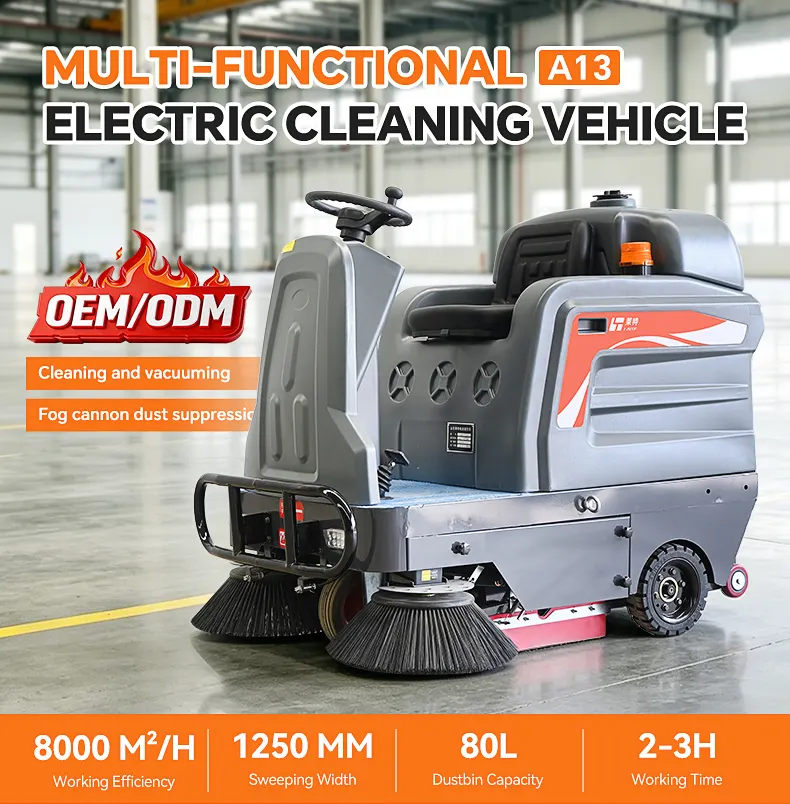
Choosing the Right Road Sweeper for Tight Urban Spaces
Compact and zero-turn road sweeper models for narrow streets
Traditional truck-mounted sweepers are ill-suited for confined urban environments. Compact models—under 1.8 meters wide—navigate alleyways and streets lined with parked cars with ease. Zero-turn technology enables pivot-like rotation within minimal space, making them indispensable for tight 90-degree corners near historic buildings. These machines typically offer 2-ton debris capacity while featuring cleaner diesel engines that cut emissions by 30% compared to legacy models (Urban Cleaning Report 2023). Enhanced panoramic visibility supports safe operation near pedestrians, and extended gutter brushes capture litter along building lines without manual intervention.
Key specifications: width, turning radius, and maneuverability metrics
Three core metrics determine urban sweeper effectiveness:
- Width (<1.8m): Enables passage through streets under 3m wide
- Turning radius (<4m): Essential for cul-de-sacs and tight intersections
- Ground clearance (>15cm): Prevents undercarriage damage on uneven surfaces
| Metric | Urban Standard | Impact on Performance |
|---|---|---|
| Sweep path | ≥1.5m | Reduces passes needed per block |
| Steering angle | ≥45° | Enables parallel curb cleaning |
| Approach angle | ≥10° | Prevents scraping on steep ramps |
Prioritizing these specifications minimizes service disruptions while maximizing debris capture near bike racks, streetlights, and other fixed infrastructure.
Overcoming Physical Constraints: Navigating Curbs, Medians, and Obstacles
How curb height and sidewalk proximity affect road sweeper operation
Curb height directly impacts collection efficacy: sweepers require 4–8 inches of clearance to avoid undercarriage damage while maintaining effective broom-to-curb contact. When curbs exceed 10 inches, collection rates drop by 30% as litter accumulates in unreachable gaps. Sidewalk proximity presents a dual challenge—operating within 12 inches risks pedestrian collisions and property damage, while staying beyond 24 inches leaves significant debris strips. Research confirms that 75% of urban waste concentrates within 18 inches of curbs. Hydraulic lift systems allow real-time height adjustments across varying terrain, and anti-collision sensors provide audible alerts when approaching sidewalks—reducing accident risk by 45%.
Strategies for safe, effective sweeping around poles, benches, and street furniture
Navigating street furniture demands precision techniques and purpose-built features:
- Angled broom deployment: Side brooms positioned at 30–45° sweep debris away from obstacles while preserving safe clearance
- Pulse-cleaning technology: Short bursts of high-pressure air dislodge trapped debris near poles without manual intervention
-
Three-pass method:
- Outer pass: Clear perimeter area
- Approach pass: Sweep toward furniture base
- Exit pass: Collect displaced debris
- Operator training simulations focused on spatial awareness reduce collision incidents by 60%
- Thermal cameras detect metallic objects like bike racks at night, enhancing off-peak safety
Slow-speed maneuvering (under 3 mph) combined with 360° lighting ensures full visibility around obstacles. Regular route mapping identifies newly installed street furniture, enabling proactive technique updates.
Specialized Broom Systems for Precision Cleaning in Confined Areas
Gutter brooms and edge brushes: maximizing debris capture along building lines
Gutter brooms and edge brushes dramatically improve cleaning performance in narrow urban corridors by targeting debris near building foundations and curbs. Their angled design and stiff poly bristles mechanically dislodge compacted material while conforming tightly to vertical surfaces—capturing up to 97% of particulate matter within 6 inches of walls (municipal sanitation studies). Optimal positioning—at 15–30° relative to the sweeper’s path—creates vortices that draw litter from corners into the main suction system. Performance data shows threefold improvement in silt removal efficiency over standard center brooms when cleaning bike lanes and sidewalk edges.
Adjustable brush pressure and tilt for variable surface conditions
Dynamic brush pressure systems (15–60 PSI) and hydraulic tilt mechanisms (0–35° bristle angle) allow operators to adapt instantly to changing surfaces—from rough asphalt to delicate pavers—without stopping. This flexibility protects historic brickwork while optimizing contact pressure for different debris types: lighter settings (~5 PSI) for autumn leaves, heavier ones (45+ PSI) for construction grit. Field testing demonstrates 40% faster clearance times when transitioning between surfaces such as plazas and alleyways.
Smart Operation: Route Planning and Technique Optimization for Road Sweepers
Effective route planning significantly improves road sweeper efficiency in constrained urban environments. GPS-guided path optimization algorithms reduce operational costs by 15–20% by minimizing redundant passes and fuel use. These systems analyze traffic patterns, historical debris accumulation data, and real-time street conditions to generate adaptive cleaning circuits.
Proper sweeping technique multiplies those gains: matching vehicle speed to broom rotation prevents particulate rebound and maintains consistent gutter contact. For example, reducing speed by 30% when navigating sharp corners improves debris capture by nearly 40% (municipal maintenance reports). Integrating digital route planning with targeted operator training ensures complete coverage of narrow streets while extending broom life through reduced lateral friction stress.
FAQ
What makes compact road sweepers suitable for urban environments?
Compact road sweepers are less than 1.8 meters wide, allowing them to maneuver through narrow streets and spaces. Features like zero-turn technology and enhanced visibility ensure they operate efficiently in tight corners near pedestrians.
What metrics should I consider when choosing a road sweeper?
Key metrics include the sweeper's width (<1.8m), turning radius (<4m), ground clearance (>15cm), sweep path (≥1.5m), and steering angle (≥45°). Each of these ensures optimal performance in urban settings.
How do road sweepers handle debris near curbs and sidewalks?
Sweepers use gutter brooms and edge brushes with adjustable pressure and tilt mechanisms. Hydraulic lifts and anti-collision sensors enhance performance and safety near sidewalks and curbs.
What is the role of GPS in route planning for road sweepers?
GPS-guided systems optimize cleaning routes by reducing redundant passes and fuel use. They analyze traffic patterns and historical data to ensure efficient coverage of urban areas.
How do adjustable brushes benefit urban cleaning operations?
Adjustable brush pressure and tilt enable operators to adapt to various surfaces and debris. This feature ensures thorough cleaning while protecting delicate surfaces like pavers.
Table of Contents
- Choosing the Right Road Sweeper for Tight Urban Spaces
- Overcoming Physical Constraints: Navigating Curbs, Medians, and Obstacles
- Specialized Broom Systems for Precision Cleaning in Confined Areas
- Smart Operation: Route Planning and Technique Optimization for Road Sweepers
-
FAQ
- What makes compact road sweepers suitable for urban environments?
- What metrics should I consider when choosing a road sweeper?
- How do road sweepers handle debris near curbs and sidewalks?
- What is the role of GPS in route planning for road sweepers?
- How do adjustable brushes benefit urban cleaning operations?