

 EN
EN
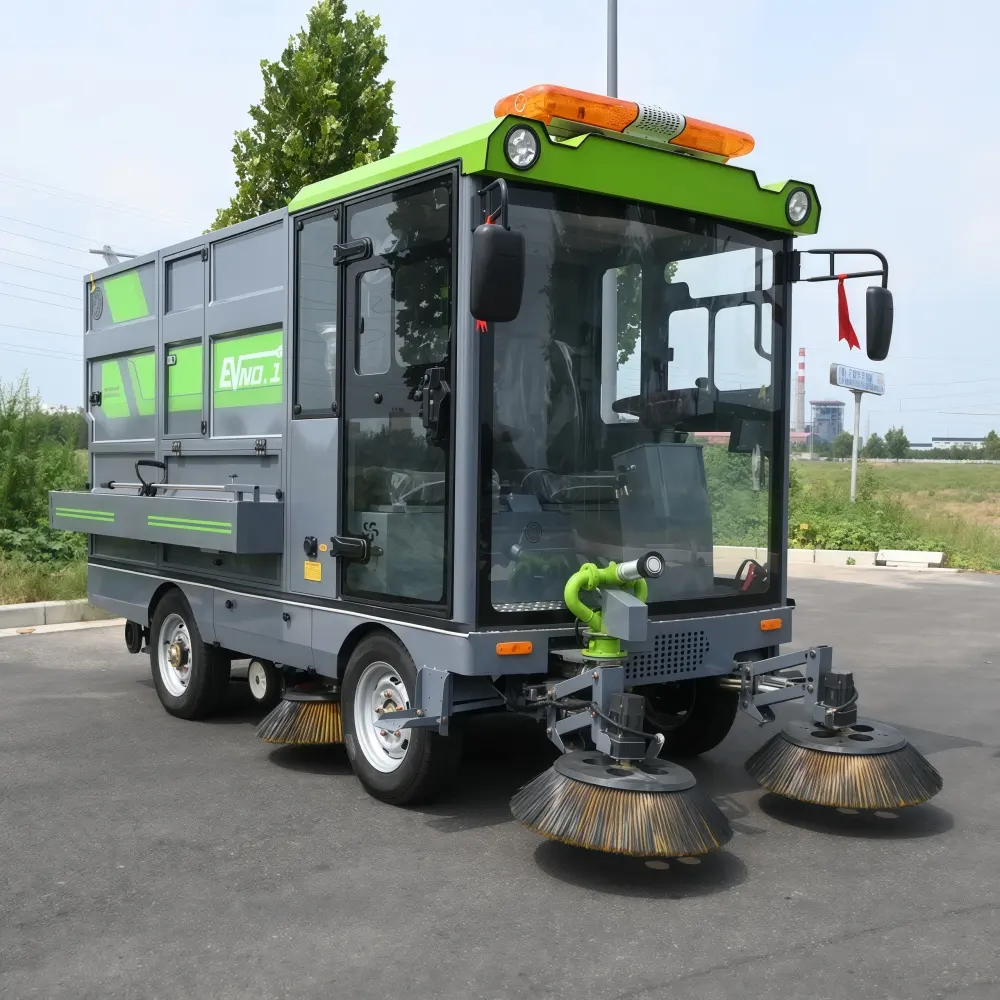
Zero Tailpipe Emissions: The Core Environmental Advantage of Electric Road Sweepers
Eliminating diesel exhaust at the source
Electric road sweepers transform urban cleaning by eliminating diesel exhaust at its source. Unlike conventional models, these battery-powered machines produce zero tailpipe emissions—removing carbon dioxide (CO₂), nitrogen oxides (NOₓ), and particulate matter from street-level operations entirely. This is especially critical in dense urban corridors, where diesel exhaust concentrates and exposes residents—particularly children and seniors—to heightened respiratory risks. By deploying electric sweepers, cities prevent hundreds of kilograms of pollutants from entering the air during daily cleaning cycles, delivering immediate, measurable improvements in local air quality.
Quantifying CO₂ and NOₓ displacement per km swept
A typical diesel road sweeper emits approximately 1.8 kg of CO₂ and 0.02 kg of NOₓ per kilometer swept. Switching to electric alternatives achieves 100% displacement of these emissions. Over a standard 40 km daily route, this prevents over 26 metric tons of CO₂ annually per vehicle—equivalent to planting roughly 1,200 mature trees. The NOₓ reduction is equally consequential: as a key precursor to ground-level ozone and urban smog, cutting NOₓ at street level supports both climate goals and public health targets. Forward-looking cities now incorporate these displacement metrics into sustainability reporting to demonstrate progress toward climate neutrality.
Dual Pollution Reduction: Lowering Particulate Matter and Urban Noise with Electric Road Sweepers
Suppression of resuspended PM₁₀ and PM₂.₅ during sweeping operations
Electric road sweepers minimize dust resuspension through integrated water-mist systems and high-efficiency vacuum filtration—capturing up to 95% of PM₁₀ and PM₂.₅ at the source. Unlike mechanical brooms that disperse settled particles, these models suppress dust plumes in real time, reducing localized airborne particulates by up to 37%, according to U.S. Environmental Protection Agency (EPA) monitoring data. This controlled containment is especially valuable near schools, hospitals, and residential zones, where fine particulate exposure directly correlates with elevated rates of asthma exacerbations and cardiovascular stress.
Noise reduction below 65 dB(A) and its public health benefits
Operating at 50–64 dB(A)—quieter than normal conversation—electric sweepers eliminate the disruptive noise of diesel engines. This enables effective nighttime and early-morning cleaning without disturbing sleep cycles, expanding operational flexibility in high-density neighborhoods. The World Health Organization identifies prolonged exposure above 65 dB(A) as a risk factor for hypertension, ischemic heart disease, and cognitive impairment in children. Peer-reviewed studies show that sustained 10 dB reductions in ambient noise correlate with 7–12% lower hospital admissions for stress-related conditions in cleaned areas—reinforcing the dual environmental and public health value of quiet, zero-emission cleaning.
Regulatory Alignment: How Electric Road Sweepers Support Urban Low-Emission Zone Compliance
Cities implementing low-emission zones (LEZs) increasingly require zero-tailpipe vehicles to meet stringent air quality standards—placing electric road sweepers at a distinct regulatory advantage. With no NOₓ or particulate emissions during operation, they fully comply with LEZ mandates that often restrict or ban internal combustion engines. Municipalities adopting electric fleets avoid non-compliance penalties while strengthening their environmental accountability. Equally important, their sub-65 dB(A) acoustic profile meets evolving urban noise ordinances—standards conventional sweepers routinely exceed. As emissions and noise regulations tighten globally, integrating electric sweepers into municipal fleets serves as a proactive, future-proof strategy aligned with broader sustainability frameworks.
Measurable Air Quality Gains: Evidence from Real-World Electric Road Sweeper Deployment
Case study: Copenhagen’s 2022–2023 fleet electrification and localized PM₂.₅ decline
Copenhagen’s 2022–2023 transition to an all-electric road sweeper fleet delivered quantifiable air quality gains across high-traffic urban corridors. By replacing diesel units, the city eliminated direct tailpipe emissions—including NOₓ and fine particulates—while leveraging precision water-spray technology and high-efficiency vacuum filtration to suppress dust resuspension. Post-deployment monitoring revealed a 15–20% reduction in localized PM₂.₅ concentrations along swept routes. This improvement was driven not only by the absence of combustion emissions but also by superior particle capture—preventing re-entrainment of PM₁₀ and PM₂.₅ that commonly occurs with mechanical sweeping. The measured decline correlated with fewer reported respiratory incidents in adjacent neighborhoods, validating the public health impact of fleet electrification. Copenhagen’s experience offers a replicable model for cities seeking credible, on-the-ground evidence of emissions reduction through sustainable infrastructure investment.
FAQs
What are the main environmental benefits of electric road sweepers?
Electric road sweepers eliminate tailpipe emissions, reduce particulate matter (PM₁₀ and PM₂.₅), and operate with lower noise levels, helping improve air quality and public health.
How much CO₂ can be saved using electric sweepers?
Switching to electric sweepers can prevent over 26 metric tons of CO₂ emissions annually per vehicle over a 40 km daily route, akin to planting 1,200 mature trees.
Do electric sweepers help meet low-emission zone regulations?
Yes, the electric road sweeper meets all low-emission zone access standards with zero exhaust output and qualifies for urban noise control specifications.
How do cities benefit financially by adopting electric sweepers?
Cities evade regulatory penalties by deploying the electric road sweeper, while gaining health and ecological benefits and achieving sustainable development assessment goals.
Table of Contents
- Zero Tailpipe Emissions: The Core Environmental Advantage of Electric Road Sweepers
- Dual Pollution Reduction: Lowering Particulate Matter and Urban Noise with Electric Road Sweepers
- Regulatory Alignment: How Electric Road Sweepers Support Urban Low-Emission Zone Compliance
- Measurable Air Quality Gains: Evidence from Real-World Electric Road Sweeper Deployment
- FAQs